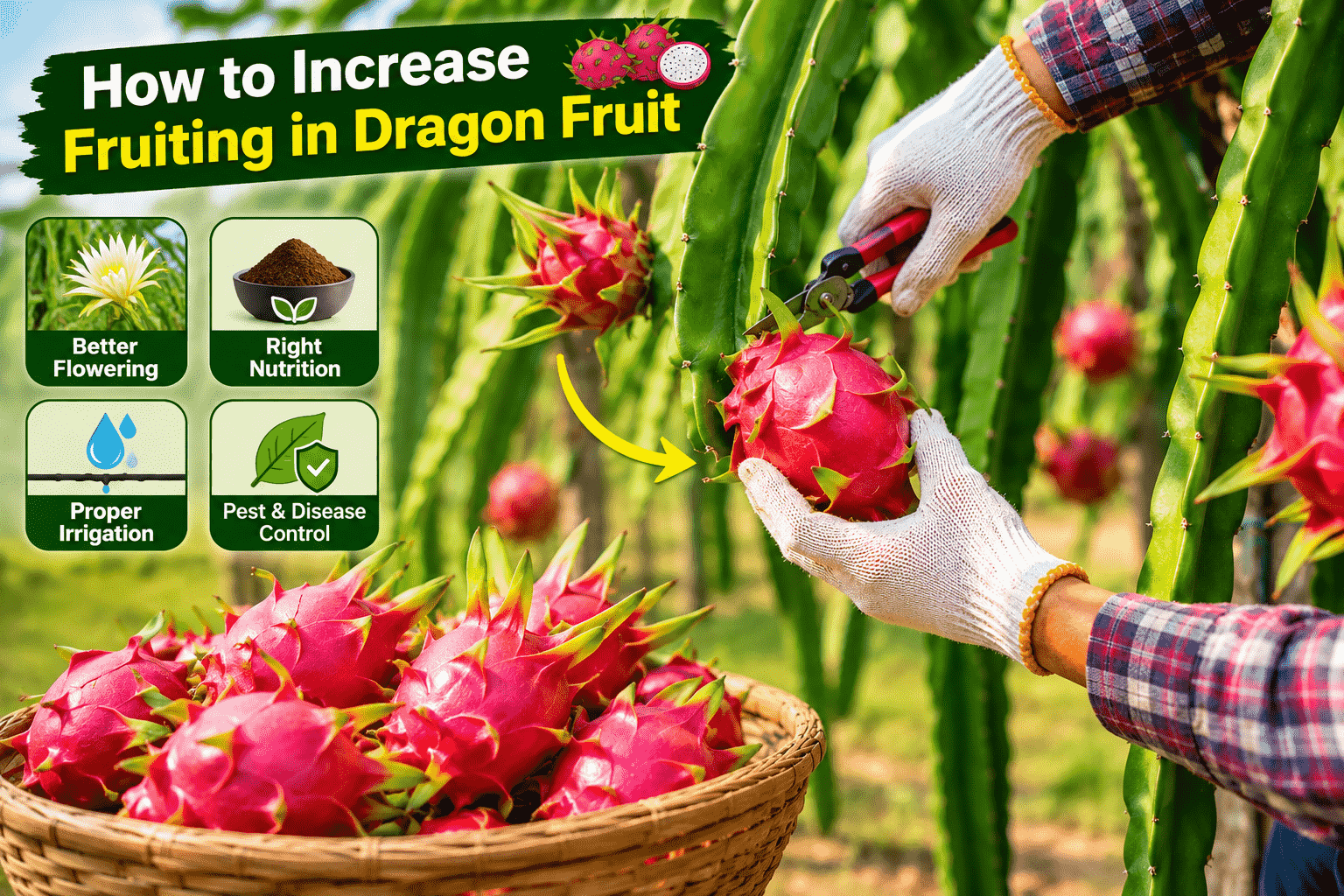
During the fruiting season, dragon fruit plants need proper nutrient and growth management to produce more flower buds, better fruit set, and good-sized fruits.
The main goal is to Increase Fruiting in Dragon fruit by just following these steps – the plant is producing too much new growth while flowering and fruiting, its resources are divided between vegetative growth and fruits. This can result in poor growth as well as smaller fruits.
Getting more fruit from dragon fruit is not simply about adding more fertilizer. Fruiting depends on a combination of healthy plants, proper nutrition, flowering, pollination, water management, weather conditions, and correct timing.
In our experience growing dragon fruit under North Indian conditions, the biggest difference comes from managing the plant according to its flowering and fruit-development stage, rather than following a fixed fertilizer schedule throughout the season.
Why Is Your Dragon Fruit Plant Not Producing Enough Fruits?
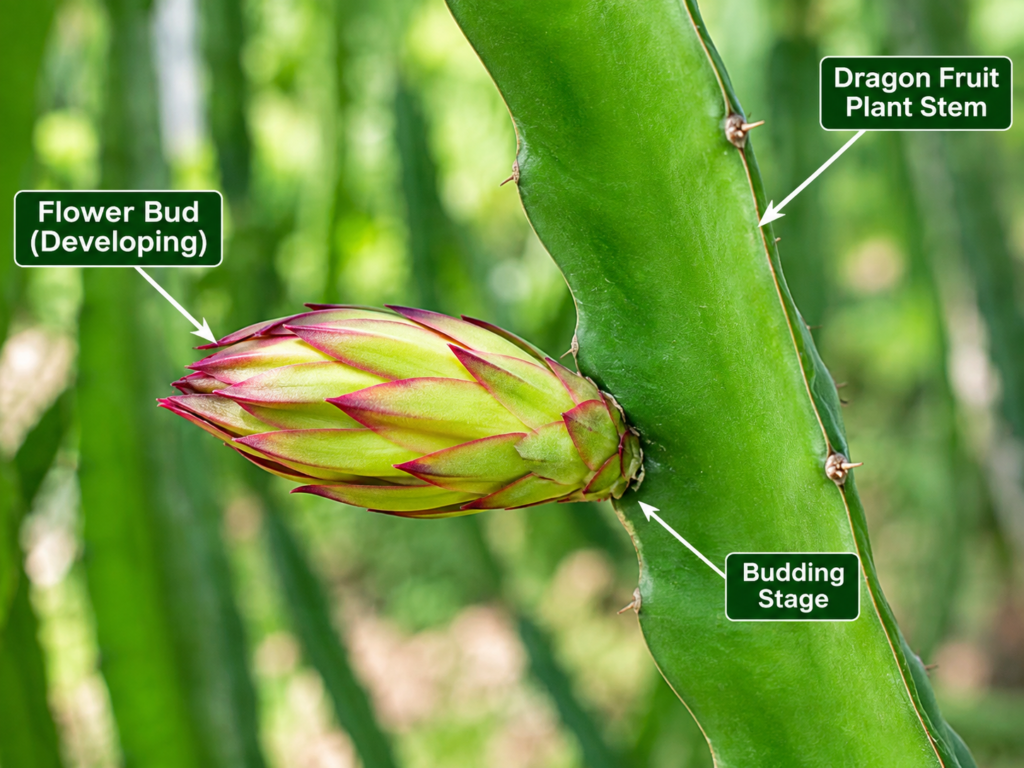
If a dragon fruit plant is growing strongly but producing very few fruits, the problem is often somewhere between flower initiation and fruit setting.
Common reasons include:
- Excessive vegetative growth with insufficient reproductive support
- Poor or irregular flowering
- Weak pollination
- Heavy rain during flowering
- Excessive nitrogen application
- Nutrient imbalance
- Water stress
- Very hot or unfavorable weather during flowering
- Too many flowers or fruits competing on a weak plant
- Poor canopy management
If you wanted to Increase Fruiting in Dragon Fruit One important point is that more fertilizer does not automatically mean more fruit. A plant can look extremely green and vigorous while still giving disappointing fruit production.
For better results, first identify whether the problem is flower production, pollination, fruit setting, or fruit development. The solution is different for each stage.
The exact dose should depend on your soil, irrigation system, plant age and existing nutrient program.
Don’t chase flowers with excessive fertilizer
This is particularly important. Increasing the fertilizer dose simply because flowering is low can backfire.
If plants are already receiving adequate nutrition, look at light exposure, plant health, water management, weather and canopy condition before increasing fertilizer.
How to Get More Flowers & Increase Fruiting in Dragon Fruit
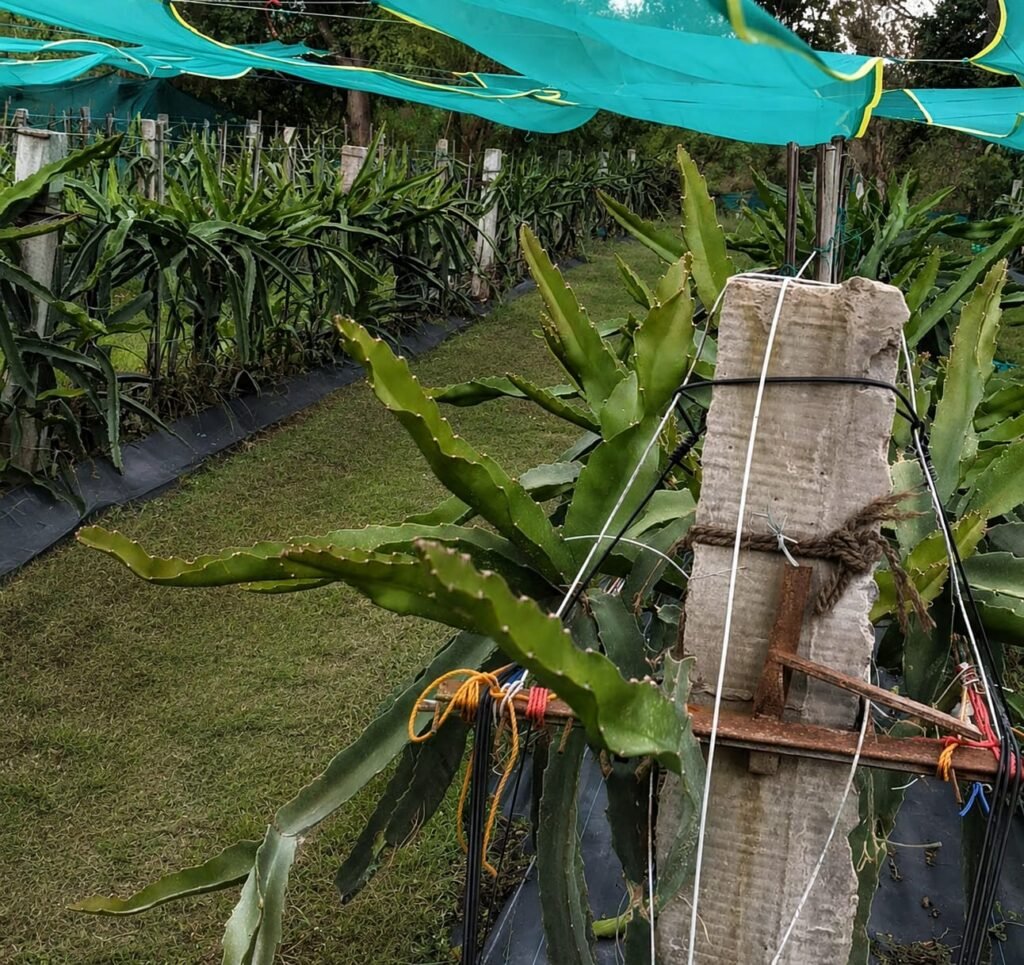
Control Excess Vegetative Growth
Before focusing on flowering, we first control excessive new growth.
Tip pruning can be done to manage the plant and encourage it to store more carbohydrates in its mature stems. After this, new unwanted growth should be monitored and controlled regularly so that it does not consume too much of the plant’s energy.
The key is to understand what the plant needs at each stage:
Vegetative growth → Flowering → Fruit development
Trying to push all three stages aggressively at the same time can affect Increase Fruiting in Dragon Fruit, fruit size and overall plant performance.
Best Fertilizer for More Fruits in Dragon Fruit
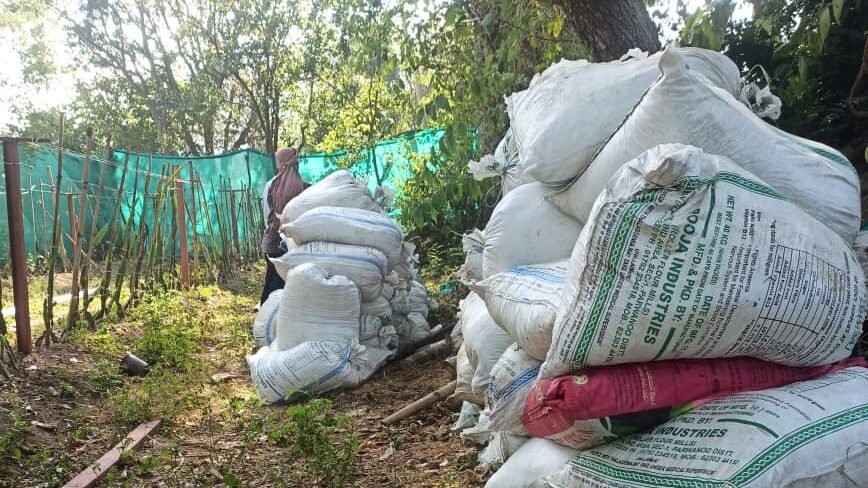
Dragon fruit responds very well to organic matter. Maintaining good organic carbon in the soil helps improve soil health and nutrient availability it will also Increase Fruiting in Dragon Fruit.
For traditionally managed plants:
- 1-year-old plants: Around 10 kg well-decomposed farmyard manure per pole
- Older, established plants: Around 20 kg farmyard manure per pole
- Neem cake: Around 100 g per plant
- Rock phosphate or PROM: Around 100–200 g per plant
- Potash: Around 100–200 g per plant
Neem cake can be useful for soil health and management of problems such as ants and nematodes. It should be viewed as part of an overall soil-management program rather than as a guaranteed solution for fruit marks.
For farmers following a chemical fertilizer program:
A basal combination can include:
- DAP: Around 100 g per plant
- NPK 12-32-16: Around 150 g per plant
- Well-decomposed manure: Around 5–10 kg per pole
The exact quantity should be adjusted according to soil fertility, plant age, irrigation, and previous fertilizer applications.
High Phosphorus for Flower Initiation
Once the plant is properly prepared, the focus shifts toward flowering.
A high-phosphorus fertilizer such as:
- 12-61-00
- 00-52-34
can be used as a foliar spray according to the product label and crop requirement.
After some time, a chelated micronutrient spray can be used to address micronutrient deficiencies.
With proper plant management and suitable weather conditions, flower buds should start appearing.
Boron + Calcium After Bud Formation
Once flower buds appear, calcium and boron become important nutrients.
A suitable calcium + boron spray can support:
- Better flower development
- Better pollination and fruit set
- Reduced risk of flower/young fruit drop
- Good fruit development
Always follow the manufacturer’s recommended concentration because calcium and boron products vary considerably in formulation and strength.
Amino Acid During Fruit Development
After fruit set, an amino-acid or protein-hydrolysate-based biostimulant can be used.
A product containing amino acids and protein hydrolysates may help support the plant during active fruit development and stress conditions.
It should be considered a supplement, not a replacement for proper nutrition.
Magnesium for Photosynthesis
A magnesium sulphate spray can be included during fruit development when magnesium is required.
Magnesium is an important component of chlorophyll and therefore plays a major role in photosynthesis.
Healthy green stems are important because the mature stems of dragon fruit are responsible for producing and storing carbohydrates that support flowering and fruit development.
7. Potassium During Fruit Development
Around the later fruit-development stage, potassium becomes particularly important.
A fertilizer such as 13-00-45 can be used according to crop requirements and label recommendations.
Potassium supports:
- Fruit development
- Fruit size
- Carbohydrate movement
- Overall fruit quality
It is often used during the fruit-filling stage, but the exact timing should depend on the fruit’s development stage rather than following a fixed number of days for every farm. follow these steps and you will get Increase Fruiting in Dragon Fruit.
How to Improve Pollination and Fruit Set
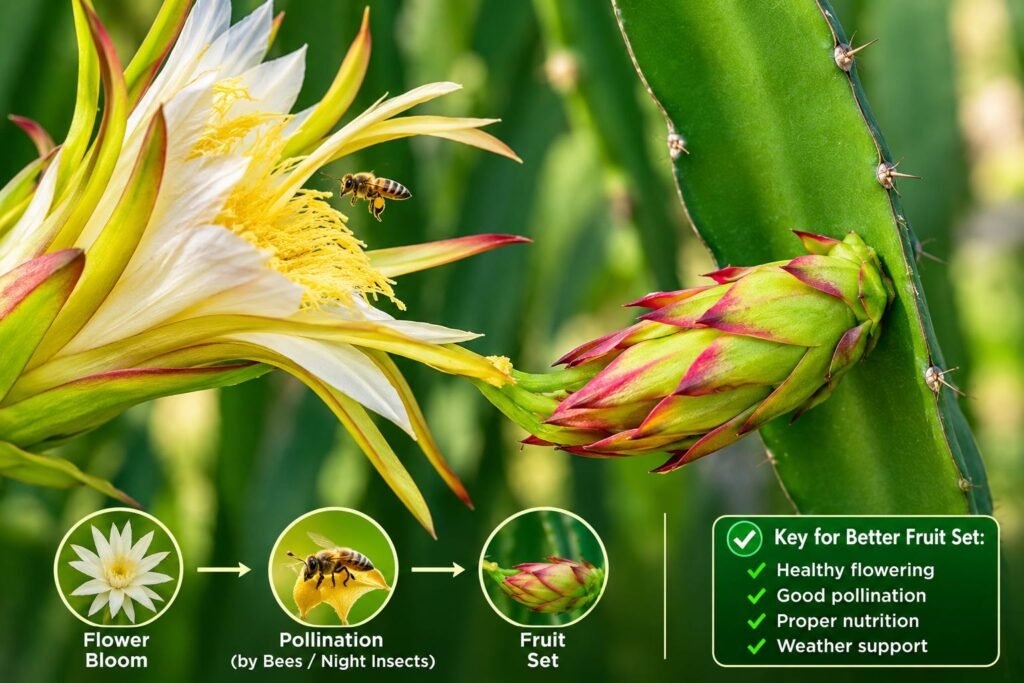
Good flowering does not always mean good fruit production.
Dragon fruit flowers open for a short period, generally at night, which makes pollination management extremely important. Depending on the variety, natural pollination may be sufficient, while some varieties benefit considerably from hand pollination.
During flowering, heavy rain can also become a serious problem. Rain can interfere with pollen and reduce successful pollination.
This is why protecting flowers from direct rainfall can be useful when weather conditions are unfavorable.
Hand pollination should ideally be performed when the flower is fully open and the stigma is receptive. Moving pollen carefully from the anthers to the stigma can improve fruit set, particularly when natural pollinator activity is low.
In commercial production, consistent pollination can sometimes make a bigger difference to final yield than simply increasing fertilizer.
How to Increase Dragon Fruit Yield – basic strategy
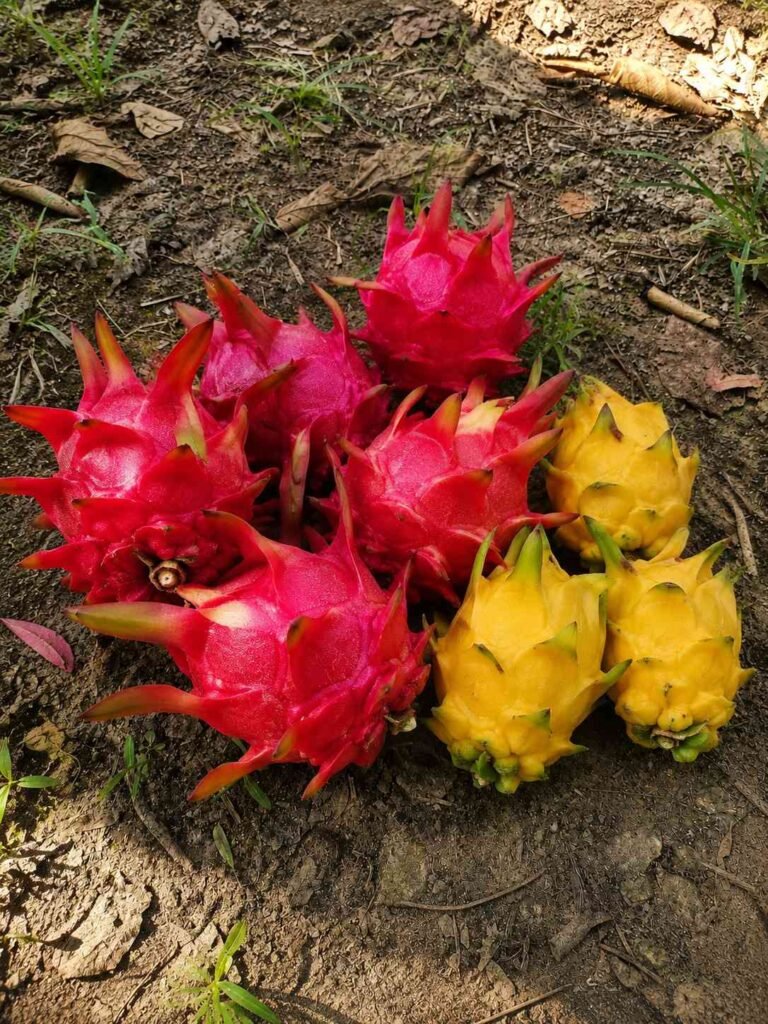
The overall approach can be summarized as:
Control excessive new growth
↓
Build a healthy soil and nutrient base
↓
Support flower initiation with phosphorus + micronutrients
↓
Support flower and fruit set with calcium + boron
↓
Support fruit development with amino acids when appropriate
↓
Maintain photosynthesis with adequate magnesium
↓
Focus on potassium during fruit filling
The most important thing is not to keep adding fertilizer simply because more fertilizer seems like it should produce more fruit. Dragon fruit responds best when nutrition, irrigation, pruning, pollination, weather, and plant load are managed together.
A good farmer should continuously observe the plant and ask: “At this stage, does my plant need more vegetative growth, more flowering support, or more fruit-development support?”
That stage-wise approach is the key to getting more flower buds, better fruit set, and larger, better-quality dragon fruits.
FAQ
What is the average size of dragon fruit sold in Indian markets?
In India, commercially sold dragon fruits are commonly around 200–400 grams per fruit. However, size varies considerably depending on the variety, growing conditions, crop load, and farm management.
At Dragon Fruit Farming India, our premium fruits generally fall in the 280–500 gram range, with many fruits around 300–450 grams.
What is the average size of a commercially grown dragon fruit?
A commercially grown dragon fruit can range from roughly 200 grams to 500+ grams. Around 300–450 grams is a good commercial size for premium fresh-market fruit.
Large fruit is not produced by fertilizer alone. Variety, plant age, irrigation, pollination, pruning, crop load, potassium nutrition, and overall plant health all influence the final size.
What is the typical size range for dragon fruit available in India?
A practical range for Indian markets is approximately 200–500 grams per fruit.
Smaller fruits may be below 200–250 g, while well-managed premium fruits can reach 400–500 g or more, depending on the variety.
Factors influencing final dragon fruit size in cultivation
The biggest factors are:
- Variety/genetics
- Plant age and maturity
- Number of fruits carried by each plant
- Pollination quality
- Irrigation during fruit development
- Potassium and other nutrient availability
- Calcium, boron and micronutrient balance
- Control of excessive new vegetative growth
- Sunlight and photosynthesis
- Weather, especially heat and prolonged rain
- Proper pruning and crop-load management
One important point from practical farming is that more flowers do not automatically mean larger fruits. If the plant is carrying too many fruits or producing excessive new growth at the same time, its resources are divided and individual fruit size can suffer.
How does dragon fruit size impact its market price?
Fruit size can have a noticeable effect on market value, especially in the premium fresh-fruit segment.
Large, uniform fruits are generally more attractive to customers and can command a better price than small mixed-size fruits. However, size alone does not determine price. Colour, sweetness, freshness, appearance, variety, packaging, and direct-to-consumer positioning also matter.
For example, a large, fresh red-flesh dragon fruit with good sweetness can be positioned as a premium product rather than competing directly with ordinary market fruit.
Where can I buy premium large dragon fruit near me?
If you are looking for premium dragon fruit around Shimla/Himachal Pradesh, you can check local farm-direct sellers rather than relying only on supermarkets.
Dragon Fruit Farming India sells farm-grown red dragon fruit directly to customers, with fruit generally in the 280–500 g range depending on the harvest.
You can also follow their harvest updates on Instagram – Dragon Fruit Farming India.
Where to buy premium large dragon fruit online?
For premium fruit, I would look for farm-direct sellers that clearly mention the variety, approximate fruit weight, harvest timing, and growing location.
This is often better than simply searching for the biggest fruit because a seller who actually grows the fruit can provide more reliable information about freshness, harvest date and fruit size.
Are there organic dragon fruit brands known for larger fruit sizes?
There isn’t one standard “organic size” for dragon fruit. Organic farming does not automatically produce larger fruits.
Increase Fruiting in Dragon Fruit – Large fruit depends more on genetics, plant health, pollination, irrigation, crop load and balanced nutrition. An organically grown fruit can be large, but certification and farming method should be considered separately from fruit size.
Tips for growing dragon fruit to achieve maximum size
The biggest mistake is to focus only on adding more fertilizer.
For larger dragon fruits:
- Select a variety with naturally good fruit-size potential.
- Keep the plant healthy before flowering.
- Control unnecessary vegetative growth.
- Maintain good pollination and fruit set.
- Avoid excessive crop load.
- Maintain consistent irrigation during fruit development.
- Provide balanced nutrition rather than excessive nitrogen.
- Give adequate potassium during fruit filling.
- Correct calcium, boron, magnesium and micronutrient deficiencies when required.
- Keep the canopy healthy so the plant can produce enough carbohydrates through photosynthesis.
The basic principle is simple: the plant needs enough healthy mature growth to produce food, but not so much competing new growth or fruit load that the available energy gets divided too heavily.