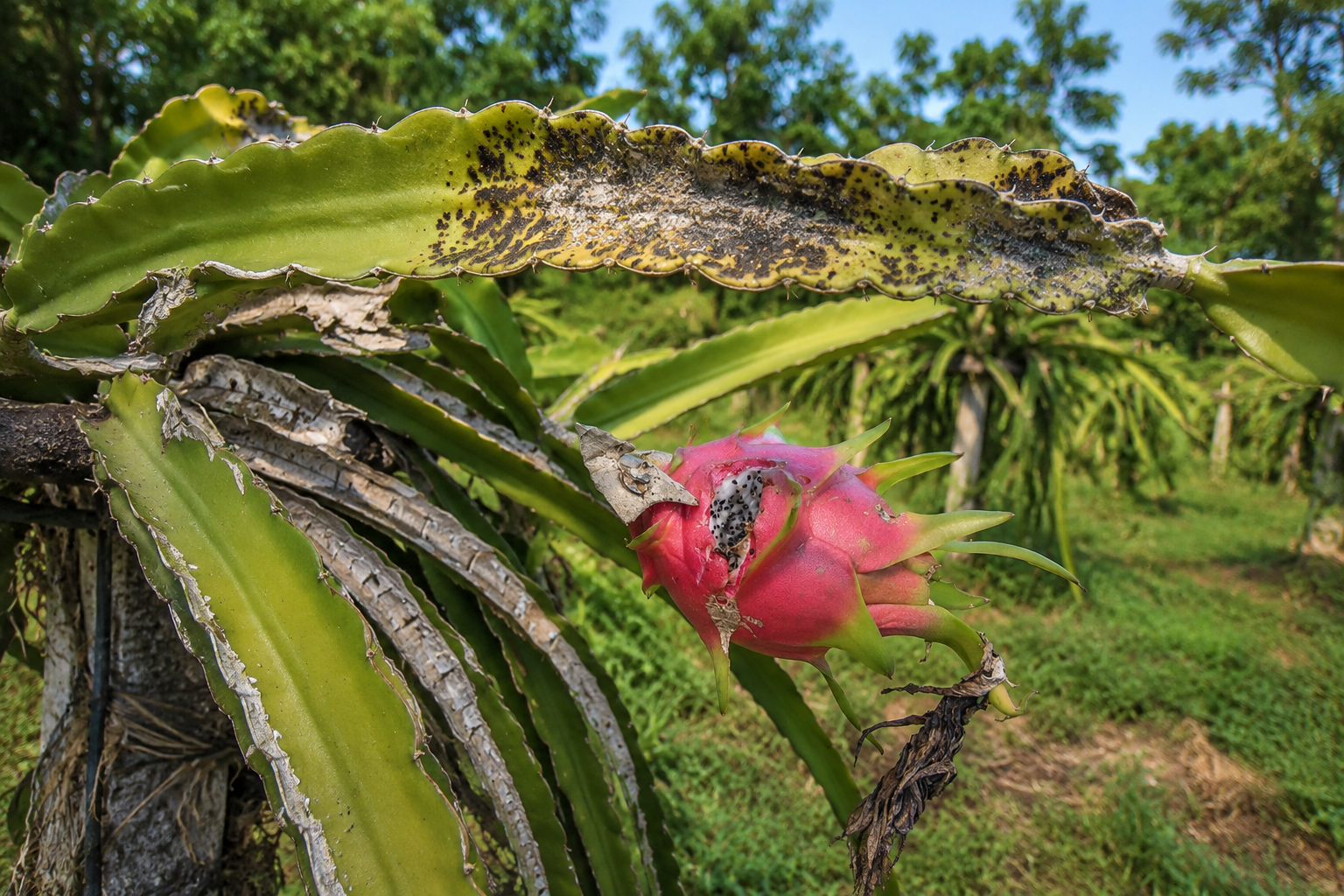
Fungal disease is one of the most serious problems that dragon fruit farmers can face, especially during the monsoon and fruiting season. Dragon fruit plants can tolerate many difficult conditions, but when continuous rain, high humidity, poor air circulation, and wet plant surfaces come together, fungal diseases can spread very quickly through an orchard.
The problem is that many farmers notice Fungus on dragon fruit only after it has already become serious. By the time the plant starts turning yellow or the infected tissue begins to rot, the fungus may already have spread inside the plant. At that stage, controlling the disease becomes much more difficult, and sometimes the farmer has no option other than removing severely infected shoots or entire plants.
There are many types of fungus, but we are now covering the most common fungus issue during fruiting season in dragon fruit farming. This is why every dragon fruit farmer should learn to identify the early signs of fungal infection. During the fruiting season, a few small spots on new growth can quickly become a major problem if the infection is ignored.
Why Dragon Fruit Fungus Becomes a Major Problem During the Fruiting Season
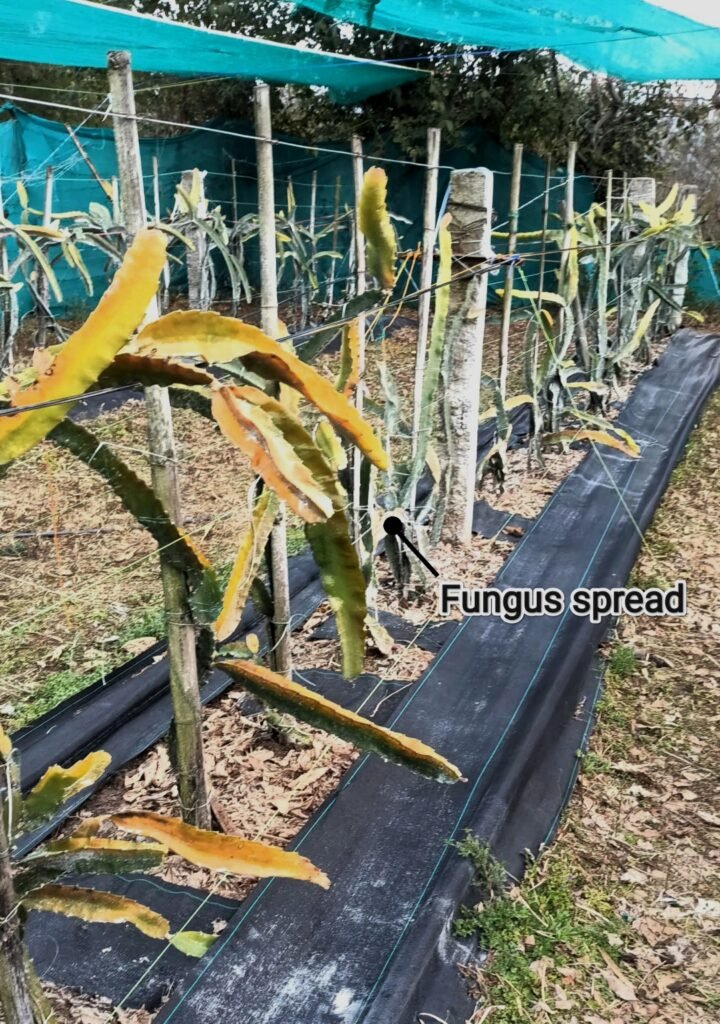
In many parts of India, the monsoon arrives at almost the same time as the dragon fruit fruiting season. This creates ideal conditions forfungus on dragon fruit. The air becomes more humid, the plants remain wet for longer periods, and repeated rainfall can keep the orchard environment damp for days.
Dragon fruit plants produce new green shoots during this period. These young shoots are soft and more vulnerable than mature, hardened branches. In my experience, fungal problems are usually first noticed on this fresh new growth. Therefore, during the rainy season, farmers should regularly inspect the light-green new shoots rather than waiting for serious symptoms to appear on mature branches.
The biggest mistake is delaying action. fungus on dragon fruit can spread rapidly under warm and humid conditions. A farmer may notice a few infected shoots today, but after several days of continuous rain, the disease can appear on many more plants. By the time the farmer decides what treatment to use, valuable time may already have been lost.
Not All Fungal Diseases Should Be Treated in the Same Way
Dragon fruit can suffer from different types of fungal diseases, and the correct treatment depends on the type and stage of infection.
Broadly, fungicides can be understood as having different modes of action. Contact fungicides remain mainly on the plant surface and help protect the outer tissue from fungal infection. Systemic fungicides, on the other hand, are absorbed by the plant and can move within plant tissues, depending on the active ingredient and formulation.
This distinction is important because a farmer should not use the same treatment for every fungal problem.
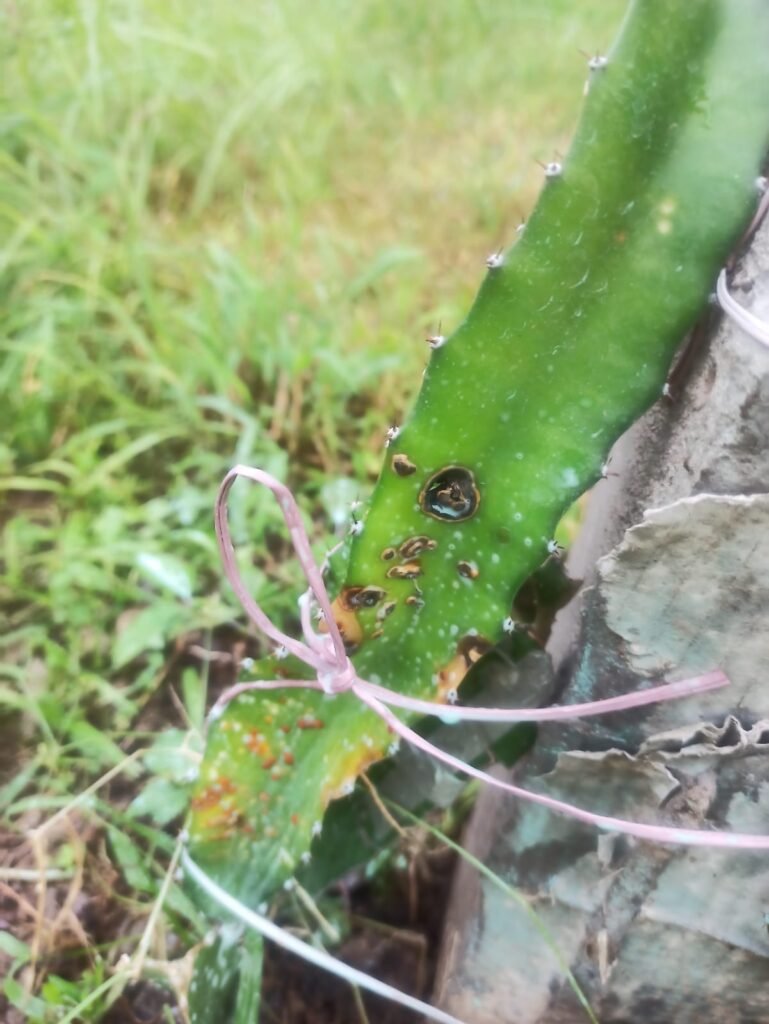
For fungus on dragon fruit, some surface infections and red or brown spot-type symptoms may respond to a suitable contact fungicide such as copper oxychloride, when used according to the product label. However, when the infection has progressed into plant tissue, a suitable systemic or systemic-combination fungicide may be required.
The disease must first be correctly identified. A brown spot, sunburn, insect damage, bacterial infection, and fungal infection can sometimes look similar. Therefore, farmers should avoid blindly spraying different fungicides without understanding the symptoms.
Early Signs of Fungus on Dragon Fruit New Shoots
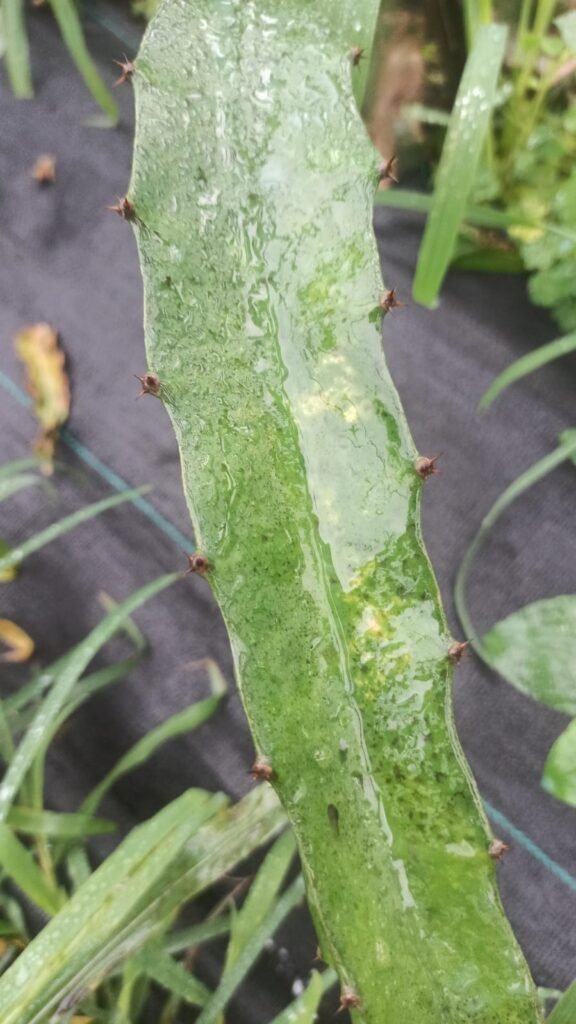
The earliest signs are often the most important because this is the stage when the disease is easiest to manage.
One early symptom that farmers should watch for is the appearance of small white spots or circular marks on young, light-green shoots. These symptoms may appear before the plant shows severe yellowing, rotting, or extensive tissue damage.
During the monsoon and fruiting season, walk through the orchard regularly and inspect the new growth closely. Do not only look at the plants from a distance. Infected areas can initially be small and easy to miss.
In my experience, mature, hardened dragon fruit shoots generally show fewer problems than fresh new growth. This is why the first signs of infection should be searched for on the soft, light-green shoots.
If only a small percentage of the shoots are showing symptoms—around 10–15%—the farmer should not wait for the infection to spread throughout the orchard. This is the time for immediate action.
What to Do When the Infection Is Still at the Early Stage
When fungal symptoms are detected early, the first step is to identify whether the infection is likely to be fungal and whether it is primarily a surface infection or one that may have entered the plant tissue.
For a suspected systemic fungal infection at an early stage, a suitable registered systemic fungicide may be considered according to the product label and local agricultural recommendations. In my own farm-management approach, products such as Spectrum may be used at the label-recommended dose, with a suitable sticker where compatible and permitted by the product label.
The exact dose should always be checked on the product label because formulations and concentrations can differ between products and manufacturers.
After treatment, the farmer should not expect the already damaged tissue to become completely healthy again. The main objective is to stop the disease from progressing and protect the healthy tissue.
After several days, observe the infected spots carefully. If the white or infected area starts becoming brown and dry rather than continuing to expand, this can indicate that the infection is no longer actively progressing. However, the plant must continue to be monitored because one spray is not always enough under continuous monsoon conditions.
Stage 2: When Fungus Has Spread to 30–40% of the Plants
When fungal infection has already reached a significant part of the orchard, the strategy needs to become more aggressive and disciplined.
First, severely infected new shoots should be removed from the plant. Do not simply cut the infected material and leave it inside the orchard. Infected plant material should be collected and removed away from the farm so that it does not become a source of further infection.
Pruning tools should also be cleaned and disinfected between infected plants where practical. Otherwise, tools can potentially help transfer pathogens from one plant to another.
After removing heavily infected material, the farmer may need a carefully planned fungicide rotation using products with different active ingredients and modes of action. The purpose of rotation is to avoid repeatedly relying on the same fungicide chemistry and to improve disease-management efficiency.
A practical rotation may include suitable registered products from different fungicide groups, such as a product based on azoxystrobin plus difenoconazole, followed by another registered fungicide with a different mode of action, and then another suitable product if required.
For example, some farmers may plan a rotation involving products such as Amistar Top, Nativo, and Spectrum. However, the exact products, doses, spray intervals, and crop approvals must be checked carefully from the current product label and local recommendations. Do not assume that a fungicide registered for one crop is automatically approved for dragon fruit.
A 4–6 day interval may be appropriate in some severe disease situations only when supported by the product label or expert recommendation. In other cases, the label may require a longer interval. The spray schedule should therefore be based on the product’s approved instructions, disease pressure, weather conditions, and the stage of the crop.
When Fungus Is Ignored, the Entire Fruiting Season Can Be Affected
The biggest loss from fungal disease is not always the death of a single branch. The real loss can be the disruption of the entire fruiting season.
A severely infected plant loses healthy growing tissue. Its new shoots may stop developing properly, infected branches may become weak, and the plant may spend its energy trying to survive instead of supporting flowers and fruits.
During the fruiting season, this can lead to:
- Loss of healthy new growth
- Flower and fruit development problems
- Reduced fruit size and quality
- Rotting of infected plant tissue
- Removal of productive branches
- Reduced yield during several fruiting waves
This is why fungal disease should not be treated as a small cosmetic problem. In a commercial dragon fruit orchard, a disease that begins on a few young shoots can become an economic problem if the farmer waits too long.
Why Fungus Spreads So Quickly During the Monsoon
Fungal diseases spread rapidly when the orchard environment remains continuously favourable for infection.
The major factors include:
- High humidity
- Frequent rainfall
- Long periods of leaf and stem wetness
- Poor air circulation
- Dense and overcrowded plant growth
- Water remaining around the plant base
- Infected plant material left inside the orchard
- Movement of workers and tools between infected and healthy plants
- Repeated rain that washes away or reduces the effectiveness of surface protection
In a dragon fruit orchard, good drainage is extremely important. Water should not remain around the root zone for long periods. Overhead irrigation should also be avoided where possible because unnecessary wetting of the plant canopy can increase disease pressure.
The objective should be to keep the plant and orchard environment as dry and well-ventilated as possible after rainfall.
How to treat dragon fruit fungus Before It Becomes a Serious Problem
The best dragon fruit fungus treatment is often prevention.
To prevent fungus on dragon fruit, keep the farm clean and remove weeds regularly. Avoid touching plants without sanitizing your hands or tools. Maintain enough spacing between rows and poles, as mature plants can merge together and reduce airflow. Good ventilation is essential, and excess moisture should be avoided. A limited amount of lime can also be added to the soil.
Farmers should not wait until 30–40% of the orchard is infected before thinking about disease management. Regular scouting should begin before the disease becomes visible across the farm.
During the monsoon and fruiting season:
- Inspect new shoots regularly.
- Look for small white, circular, brown, or abnormal spots.
- Remove severely infected plant parts quickly.
- Take infected material away from the orchard.
- Avoid unnecessary overhead irrigation.
- Maintain proper drainage.
- Improve air movement by avoiding excessive overcrowding.
- Clean pruning tools after working on infected plants.
- Use fungicides responsibly and rotate modes of action where appropriate.
- Always follow the product label, approved crop use, dose, spray interval, and pre-harvest requirements.
Fungicide rotation is especially important when disease pressure is high. Repeatedly spraying the same active ingredient can increase the risk of reduced sensitivity or resistance in fungal populations. Therefore, farmers should not keep using the same fungicide continuously throughout the season.
A Practical Monsoon and Fruiting-Season Fungus Management Approach
A good management plan should begin before the disease becomes severe.
During the early monsoon, inspect the orchard frequently, especially after periods of continuous rain. If early symptoms appear on a small number of new shoots, identify the disease correctly and take immediate action.
To prevent fungus on dragon fruit, keep the farm clean and remove weeds regularly. Avoid touching plants without sanitizing your hands or tools. Maintain enough spacing between rows and poles, as mature plants can merge together and reduce airflow. Good ventilation is essential, and excess moisture should be avoided. A limited amount of lime can also be added to the soil.
Always look for fungus on dragon fruit before starting any work – If the disease is spreading, remove heavily infected tissue and follow a properly planned fungicide programme using approved products with different modes of action. Do not mix multiple fungicides together unless the product labels or a qualified agricultural expert confirm that the combination is compatible.
The most important thing is consistency. A farmer cannot spray once and then ignore the orchard for the next two weeks during continuous rainy weather. Disease pressure can change quickly, so the crop must be monitored regularly.
Important Advice for Dragon Fruit Farmers
Fungal disease during the dragon fruit fruiting season is a problem that should be taken seriously, especially in areas where monsoon humidity remains high.
The key is to catch the disease early. Small white spots or unusual marks on new light-green shoots should not be ignored. When only a small part of the orchard is affected, there is a much better chance of stopping the problem before it spreads widely.
Once the infection has spread across a large percentage of the orchard and plants begin turning yellow or rotting, the situation becomes much more difficult and expensive to manage.
For this reason, farmers should remember one simple rule:
Do not wait for a serious fungal attack before starting disease management. Inspect the new growth, identify the early signs, remove infected material, improve orchard conditions, and use the correct fungicide strategy before the disease gets out of control.
Important: Fungicide names, doses, crop registrations, spray intervals, and pre-harvest intervals can vary by formulation and product label. Always verify the current label and approved use for dragon fruit before spraying.
FAQ
Q1- How do you treat fungus on dragon fruit plants?
Ans- Dragon fruit fungus treatment – Remove severely infected shoots, improve drainage and air circulation, and use a suitable registered fungicide according to the product label. Early treatment is much more effective than waiting for the plant to turn yellow or rot.
Q2- What is the best fungicide for dragon fruit plants?
Ans- There is no single best fungicide for every fungal disease. Contact fungicides may help with surface infections, while systemic fungicides may be required when the infection has entered the plant tissue.
contact fungicide - Copper Oxychloride
systematic fungicide - Amistar Top, Nativo, spectrum
Q3- What is the fungal disease in dragon fruit?
Ans- Dragon fruit can suffer from several fungal diseases that cause white spots, brown lesions, stem spots, yellowing, and rotting. The correct disease should be identified before selecting a fungicide.
Q4- How do I know if dragon fruit is bad?
Ans- A spoiled dragon fruit may have a foul smell, excessive softness, leaking juice, mould, or large dark, sunken areas. Minor marks on the skin do not always mean the fruit is spoiled.
Q5- Why does fungus attack dragon fruit during the monsoon?
Ans- High humidity, frequent rainfall, prolonged moisture, and poor air circulation create ideal conditions for fungal diseases. This is why fungus can spread quickly during the monsoon and fruiting season.
Q6- What are the early signs of fungus on dragon fruit plants?
Ans- Small white spots, circular marks, brown lesions, or unusual patches on young light-green shoots can be early signs of fungal infection. Regularly checking new growth helps detect the problem early.
Q7- Can infected dragon fruit shoots be saved?
Ans- Early infections may be controlled with proper treatment, but severely infected or rotting shoots should generally be removed from the orchard. This helps reduce the risk of the disease spreading to healthy plants.
Q8- How can I prevent fungus in dragon fruit during the rainy season?
Ans- Maintain good drainage, improve air circulation, avoid unnecessary overhead irrigation, remove infected plant material, and inspect new shoots regularly. Early prevention is easier than controlling a severe fungal attack.