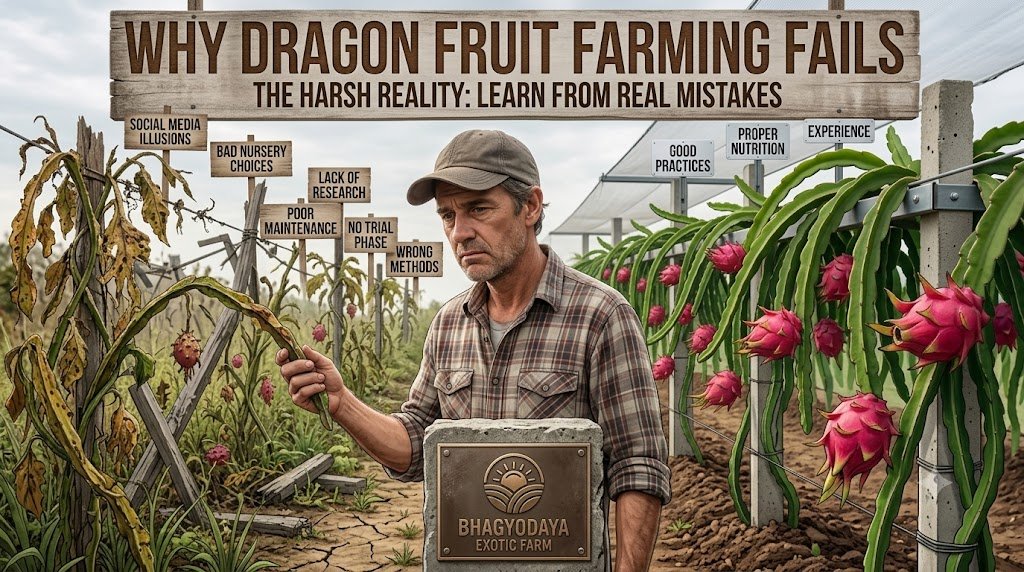
Hello fellow farmers and agriculture enthusiasts! I am Himanshu, and I welcome you to another deep dive based on my personal journey at Bhagyodaya Exotic Farm, located in the beautiful hills of Bhumti, near Shimla. Over the years, I have spent countless hours observing, testing, and perfecting the art of growing this exotic cactus in a terrain where many thought it was impossible.
Today, we are going to talk about a very serious and often ignored topic. If you open YouTube or scroll through social media, you will see hundreds of videos showing farmers becoming millionaires overnight by growing this exotic fruit. But the ground reality is vastly different. The truth is, a large number of people who start this venture end up losing their hard-earned money.
In this comprehensive guide, I am going to share my personal experiences and outline the exact reasons behind these failures. By understanding the core of dragon fruit cultivation in India, you can protect your investment and build a sustainable, profitable farm. Let’s deeply analyze why dragon fruit farming fails and what you must do differently to ensure your farm thrives.
Reason 1: The “Dekha-Dekhi” (Copy-Paste) Syndrome and Social Media Illusions
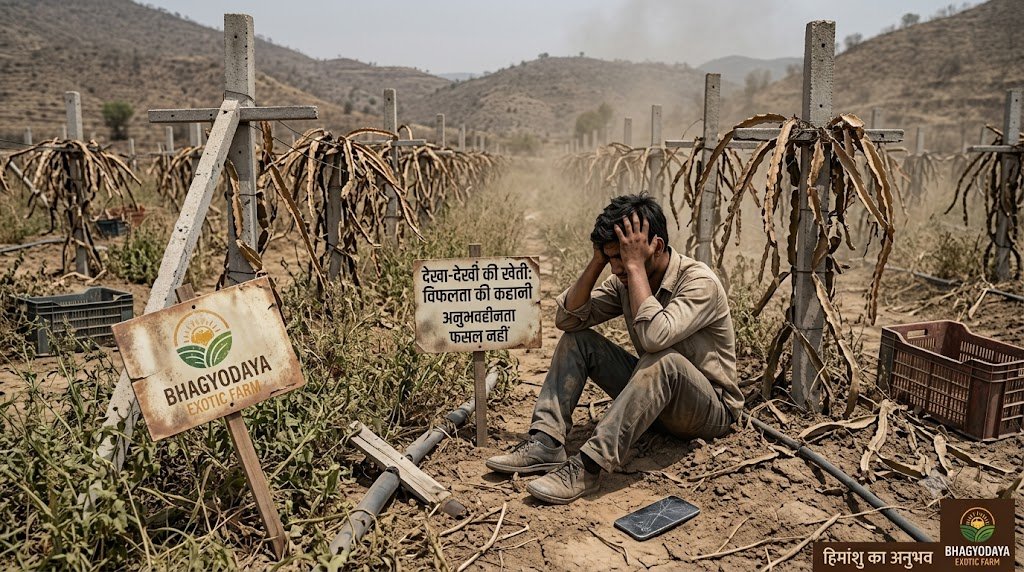
The absolute first and most prominent reason for failure is “dekha-dekhi”—which translates to blindly copying others based on what you see.
When this fruit first started gaining popularity in the country, social media platforms and YouTube were flooded with exaggerated success stories. Influencers and content creators showcased farmers allegedly making 10 lakh to 20 lakh rupees per acre with zero effort. They painted a picture of a magical money-making tree. However, what these videos completely failed to show was the intense, back-breaking hard work, the daily monitoring, and the steep learning curve required to maintain an orchard.
Agriculture, especially exotic horticulture, is never a get-rich-quick scheme. When new growers enter this field purely driven by the FOMO (Fear Of Missing Out) created by YouTube, they lack the mental preparedness for the actual labor involved. They expect to plant the cuttings, go home, and return a year later to harvest premium fruits. This illusion is one of the most fatal dragon fruit farming mistakes a beginner can make.
The reality is that this specific farming requires a massive initial capital investment for infrastructure, constant monitoring for fungal infections, precise nutritional management, and immense patience. When the promised “instant wealth” doesn’t materialize in the first 12 to 18 months, farmers get frustrated, abandon their fields, and the project collapses. If you want to succeed, you must stop looking at YouTube earnings and start looking at the soil, the plant structure, and the daily grind required. Understanding this psychological trap is the first step in understanding why dragon fruit farming fails.
Reason 2: Zero Research and Buying from Fraudulent Nurseries
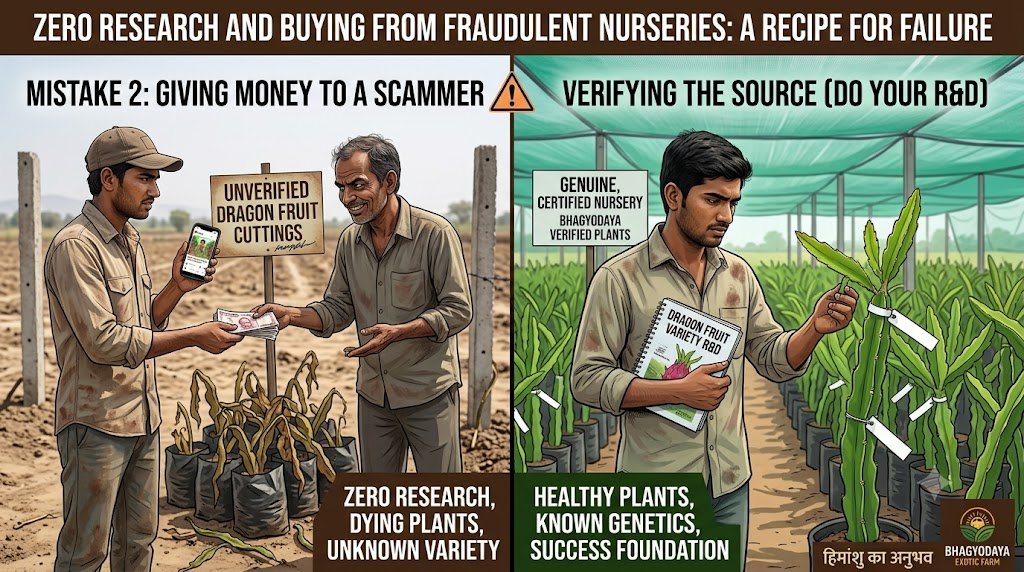
The second major roadblock is diving into the business without doing any R&D (Research and Development). In the rush to start planting, farmers often skip the most crucial step: sourcing the right planting material.
Because the demand for these plants has skyrocketed, thousands of unverified, opportunistic nurseries have popped up overnight. Many of these sellers have absolutely no practical knowledge of genetics or farming; they are simply buying cheap cuttings in bulk and reselling them at a premium to naive buyers.
This lack of research is one of the most expensive dragon fruit farming mistakes you can encounter. A farmer without proper knowledge ends up trusting these fake nursery owners blindly. They purchase thousands of saplings that are often diseased, belong to a poor-yielding variety, or are just immature cuttings that will take years to root properly.
When you start your foundation with weak or incorrect plant material, no amount of fertilizer or care will fix it. You will spend money on labor, poles, and irrigation, only to realize two years later that your plants are not producing any fruit. To secure your future in dragon fruit cultivation in India, you must visit established farms, ask questions, verify the mother plants from which the cuttings were taken, and ensure you are buying mature, disease-free saplings from a trusted source. Do your own research, study the market, and never buy plants blindly just because they are cheap.
Reason 3: Skipping the Trial Phase (The 160+ Varieties Dilemma)
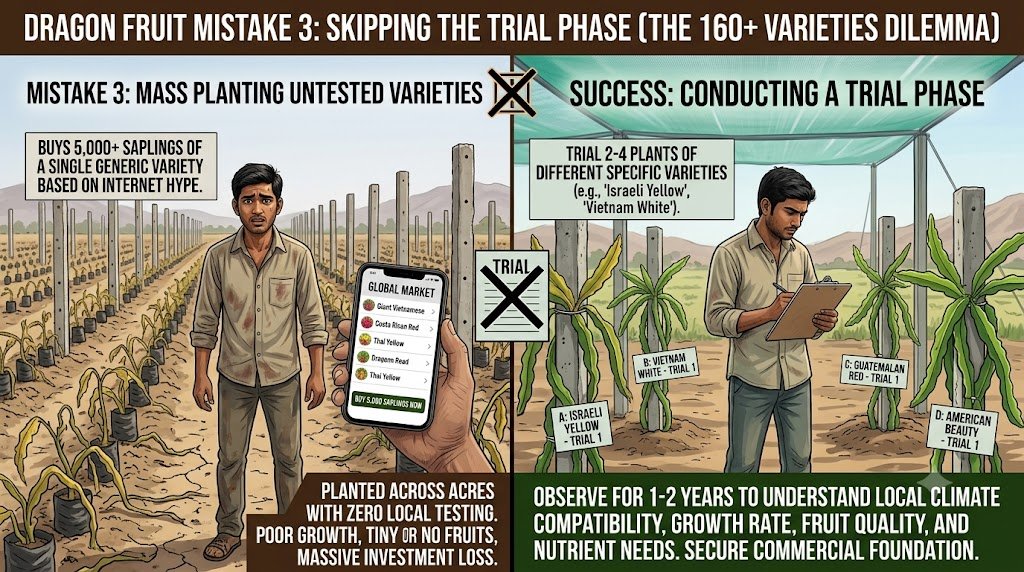
This brings me to my third point, which is deeply connected to the lack of research: planting on a massive scale without conducting a trial first.
Many people think this is just a standard crop—you buy a seed or a cutting, put it in the dirt, and it will grow anywhere. This is a massive misconception. Did you know there are over 160 different varieties of this fruit? Each variety has its own specific requirements for soil pH, temperature tolerance, humidity, and fruiting cycles. For instance, on my farm, I focus heavily on Red and Israeli Yellow varieties because I have tested how they respond to my specific environment.
A variety that gives massive yields in the coastal humidity of South India might completely stunt and freeze in the colder, hilly terrains of the North. Yet, farmers regularly commit terrible dragon fruit farming mistakes by importing thousands of saplings of a random variety and planting them across acres of land without testing them first.
What happens next? The plants sit dormant. For two whole years, the variety simply refuses to grow because it is entirely incompatible with the local soil or climate. Even if it survives, the fruit size remains tiny, making it unsellable in the premium market. This is a classic textbook example of why dragon fruit farming fails.
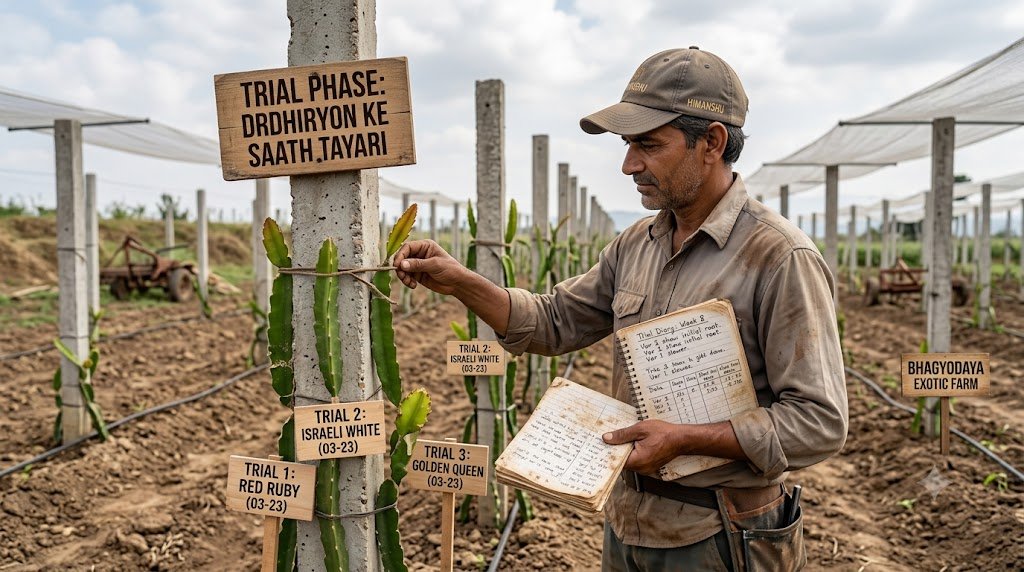
The golden rule for dragon fruit cultivation in India is to always start small. Never plant 1,000 saplings on day one. Bring 2 to 4 plants of different varieties. Plant them, care for them, and observe their entire life cycle for at least a year. Watch how they react to your local summer heat, your monsoon rains, and your winter chills. Only when you see which specific variety naturally thrives and produces good fruit size in your exact soil should you scale up to a commercial level.
Reason 4: The “It’s Just a Cactus” Myth and Lack of Maintenance
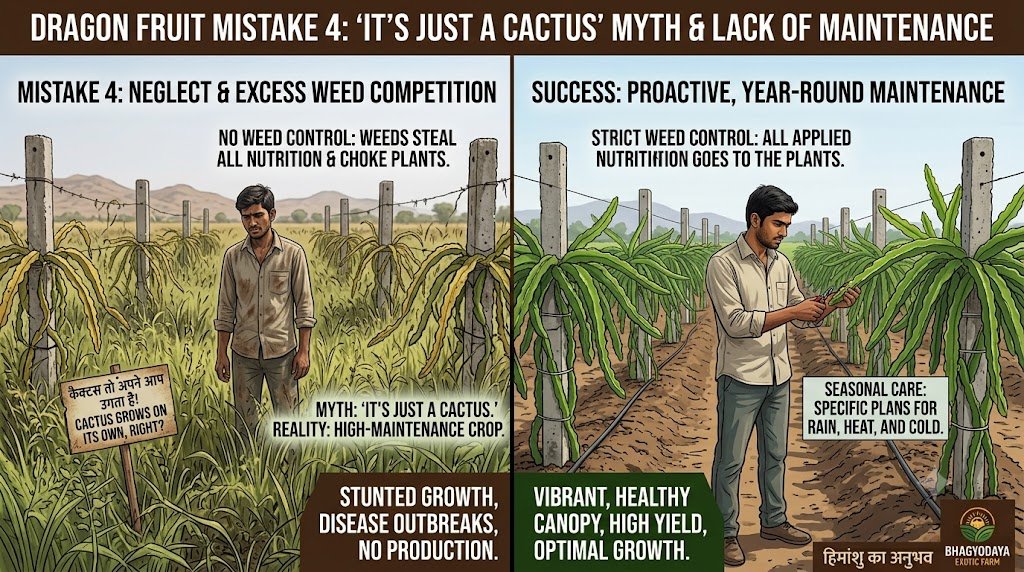
Point number four is a myth that has destroyed countless acres of beautiful orchards: “It is a cactus, so it doesn’t need any maintenance or water.”
If you believe that you can just plant it and forget it, you are setting yourself up for guaranteed failure. While it belongs to the cactus family, a commercial fruiting dragon fruit plant is a highly demanding organism. It requires distinct and specific care during every season of the year.
In the extreme heat of the summer, the plants are highly susceptible to sunburn, which turns the stems yellow and halts photosynthesis. To combat this, I highly recommend installing white shade netting over the crop to diffuse the harsh sunlight and protect the canopy. In the winter, the cold can cause frost damage, and the plant goes into dormancy.
But the most critical season is the monsoon. During heavy rains, if water logs near the roots, the plant will suffer from severe fungal diseases and root rot. Furthermore, the monsoon brings rapid weed growth. If you do not perform strict weed control during the rainy season, the weeds will choke your plants. They will steal all the expensive foliar nutrition you apply—like magnesium sulphate, amino acids, and your 0:52:34 fertilizers. If the weeds steal the food, your plants will stop growing for years.
Treating this high-value crop like a wild desert cactus is among the worst dragon fruit farming mistakes possible. It requires a meticulously planned schedule of micro-nutrients, regular pruning, pest management, and canopy care. Ignoring this reality is a massive reason why dragon fruit farming fails. If you want to master dragon fruit cultivation in India, you must be prepared to manage your farm proactively 365 days a year.
Reason 5: Choosing the Wrong Planting Method and Poor Canopy Management
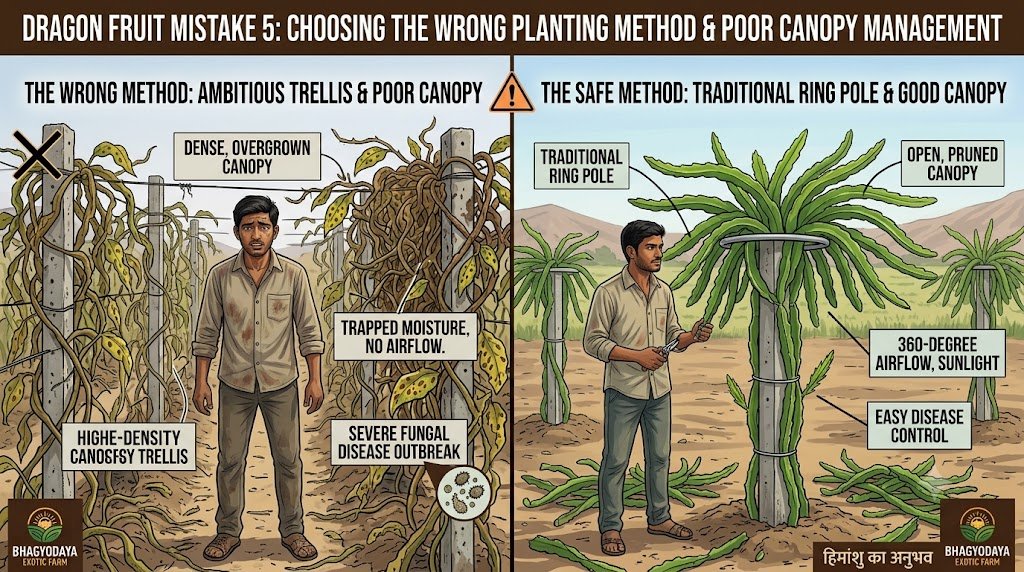
The fifth and final major reason for failure comes down to structural engineering and farm layout: using the wrong planting method and failing to manage the canopy.
Generally, there are two primary methods for plantation: the traditional Ring and Pole method, and the High-Density Trellis method. Both have their pros and cons, but choosing the wrong one for your skill level can be disastrous.
The Trellis method involves planting in continuous rows with a wire support system. On my farm, I utilize sturdy concrete trellis poles combined with a robust wire support system to hold the heavy weight of the mature vines. The Trellis method allows you to plant significantly more saplings in a smaller area, mathematically leading to higher potential profits. However, because the plants are packed so closely together, the canopy becomes extremely dense. If you lack experience, this dense canopy restricts airflow and traps moisture, creating a perfect breeding ground for severe fungal infections. A disease can wipe out an entire row in a matter of days.
Many beginners see the high-profit projections of the Trellis system and immediately adopt it without understanding the advanced canopy management required. This leads to massive disease outbreaks, poor fruit quality due to lack of sunlight penetration, and eventual farm collapse. This structural mismanagement is exactly why dragon fruit farming fails for overly ambitious beginners.
For someone just starting out, the traditional Ring and Pole method is far safer. It keeps the plants separated, allows for excellent 360-degree airflow, makes pruning much easier, and significantly reduces the risk of widespread disease. Rushing into advanced, high-density methods without the necessary hands-on experience is one of the most fatal dragon fruit farming mistakes. To ensure long-term success in dragon fruit cultivation in India, it is always better to start with the safer Ring and Pole method, master the art of canopy pruning, and only move to Trellis systems once you truly understand the plant’s behavior.
Conclusion: Patience and the Trial Method
Farming is an art, a science, and a test of patience. The stories of instant wealth are largely fictional, designed to generate clicks and sell saplings. Real farming is about sweat, observation, and continuous learning.
If there is one key takeaway I want you to remember from my experience at Bhagyodaya Exotic Farm, it is this: start small. When you decide to step into this beautiful yet challenging world, do your research. Find a genuine farmer, not just a nursery salesman. Buy just 2 to 4 plants. Put them in your soil, watch them grow, feed them, and learn their language.
Understand how they react to your local weather, figure out your irrigation needs, and practice your pruning techniques on those few plants. Once you have seen their entire cycle and successfully harvested your first fruits, you will have the confidence and the exact blueprint needed for your specific land.
By avoiding the temptation of social media hype, doing proper research, prioritizing maintenance, and choosing the right structural methods, you can secure your investment. Understanding these pitfalls is the ultimate secret to successful dragon fruit cultivation in India. Don’t let your hard work go to waste. Now that you know exactly why dragon fruit farming fails, you are fully equipped to build an orchard that will yield beautiful, sweet fruits for decades to come.