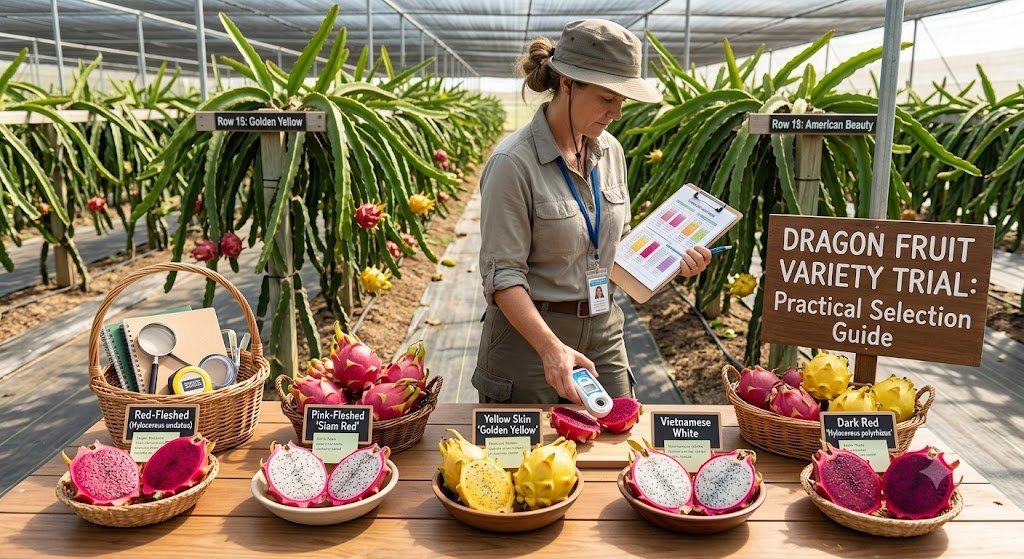
Welcome to our comprehensive guide on selecting the best dragon fruit variety for your plantation. Whether you are setting up a commercial orchard or planting a few vines in your backyard, making the right choice early on dictates your future success. Many growers jump into dragon fruit farming by purchasing whatever saplings are easily available, only to regret it years later when the yields are low or the fruits lack sweetness. Finding the ideal fit takes patience, research, and practical testing.
Why Variety Selection is the Heart of Dragon Fruit Farming
Every geographical region has unique soil profiles, temperature fluctuations, and humidity levels. What grows perfectly in coastal regions might struggle in the mountains. To truly find the best dragon fruit variety, you cannot rely solely on internet research; you need on-ground trials. At our farm in Bhumti, located about 50km from Shimla in Himachal Pradesh, we faced this exact challenge. Instead of committing our entire acreage to one unproven plant, we decided to run a structured, year-long trial to determine the winner.
Our Practical Trial: Testing Popular Varieties
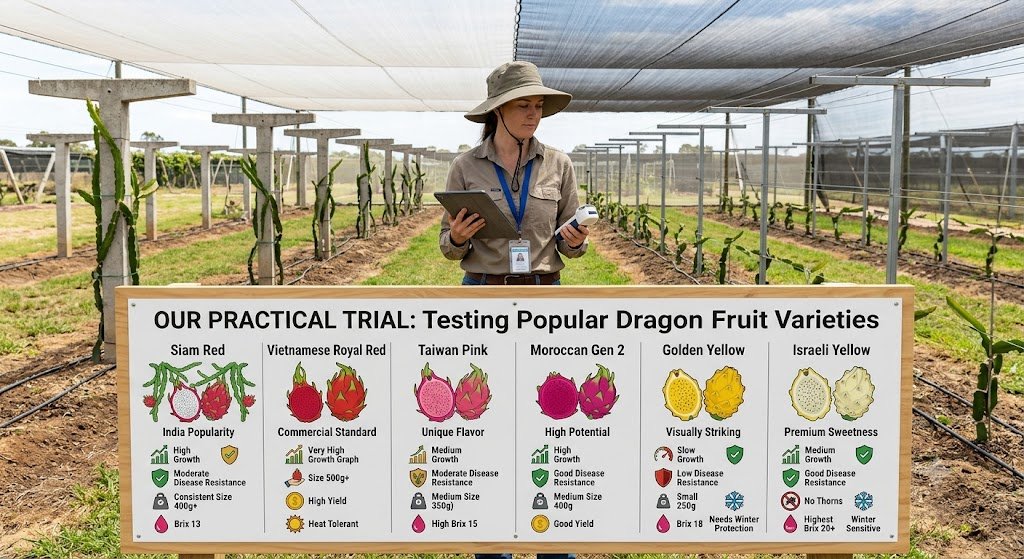
We wanted to identify the absolute best dragon fruit variety for our specific microclimate. To do this, we sourced several popular and exotic cultivars and planted them side-by-side under the exact same conditions. We used our standard concrete trellis poles equipped with a wire support system and installed white shade netting to protect the young crops.
The varieties we put to the test included:
- Siam Red: Highly popular across India for its vibrant color and reliable yield.
- Vietnamese Royal Red: Known for large commercial appeal and vigorous growth.
- Taiwan Pink: Often praised for its unique flavor profile.
- Moroccan Gen 2: A newer, high-potential cultivar.
- Golden Yellow: A visually striking yellow-skinned variety.
- Israeli Yellow: A premium variety known for high sweetness and lack of thorns on the fruit.
By putting these through a full year of changing seasons, we gathered practical data to optimize our approach to dragon fruit farming.
The 6-Step Criteria to Select the Best Dragon Fruit Variety
We evaluated each plant across a full calendar year, observing how they handled every season and stress test. If you want to replicate this process, here are the exact criteria we used to judge the performance of each cultivar.
1. Vegetative Growth Rate
The first thing we measured was the sheer vigor of the plant. In the early stages of dragon fruit farming, you want a plant that climbs the trellis efficiently and forms a strong, healthy canopy. Some varieties remained stunted for months, while others aggressively pushed out new shoots. We tracked the monthly vertical growth to see which plant established itself the fastest.
2. Disease and Pest Resistance
A fast grower is useless if it constantly falls victim to fungal infections like stem rot or anthracnose. During the humid monsoon months, we closely monitored the branches. The best dragon fruit variety for your farm must possess a natural resilience to local pathogens, reducing your reliance on heavy chemical interventions and foliar sprays.
3. Fruiting Waves and Overall Yield
Once the plants matured, we tracked the fruiting cycles. How many “waves” of flowers and fruits did the plant produce in a single season? Some varieties gave one massive flush and then stopped, while others provided consistent, smaller waves throughout the summer and autumn. Consistent yields are a critical factor in profitable dragon fruit farming, as they ensure a steady supply for direct-to-consumer marketing and social media sales.
4. Fruit Size and Appearance
Market appeal matters. We weighed the fruits from each variety. Did the plant produce small 200-gram fruits, or did it consistently push out premium 400 to 600-gram fruits? Furthermore, we looked at the shape, the color of the bracts (scales), and the overall visual appeal.
5. Brix Level (Sweetness)
Looks do not guarantee repeat customers; taste does. We used a refractometer to measure the Brix level (sugar content) of every variety. For instance, while some red varieties looked beautiful, their Brix levels hovered around 13-14. In contrast, Israeli Yellow often pushes much higher, offering an intense sweetness. The best dragon fruit variety must strike a perfect balance between size and high Brix levels to satisfy consumer demand.
6. Extreme Weather Tolerance
This was the ultimate test in Himachal Pradesh. Our farm experiences intense summer heat and biting winter cold. We documented how the plants reacted to these extremes. Did the branches turn yellow and suffer frostbite in January? Did they get sunburned in June? The best dragon fruit variety is the one that survives your local climate’s harshest months with minimal damage under the shade net.
How You Can Replicate This Method
You do not need to guess when starting out. You can apply our methodology to your own dragon fruit farming journey by following these simple steps:
- Create a Test Plot: Dedicate a single row or a few concrete trellis poles specifically for testing.
- Source Wisely: Buy 3 to 5 saplings of 4 different varieties. Ensure you buy from reputable nurseries so the genetics are authentic.
- Standardize Nutrition: Treat them all equally. Apply the exact same basal dose and foliar sprays (like your magnesium sulphate and amino acid blends) across all test plants.
- Keep a Journal: Document their growth every month. Take photos. Record the first flowering date, the harvest date, the fruit weight, and the Brix score.
After 12 to 18 months, the data will clearly show you which is the best dragon fruit variety for your specific soil and climate. You can then confidently propagate cuttings from the winning plant to expand your farm.
Finding the best dragon fruit variety requires moving past theoretical advice and embracing practical, on-farm trials. By testing cultivars like Siam Red and Israeli Yellow against strict criteria—growth, disease resistance, yield, Brix, and weather tolerance—we found what works best for our farm near Shimla. We highly recommend you conduct a similar trial. Taking the time to test your plants is the smartest investment you can make in the future of your dragon fruit farming business.
Frequently Asked Questions (FAQs)
1. Which is the best dragon fruit variety for beginners in India?
For absolute beginners, Siam Red and Taiwan Pink are often recommended because they adapt well to various climates, grow vigorously, and are generally self-pollinating, making them easier to manage.
2. How long does it take to test a new variety?
You should run your trial for at least 12 to 18 months. This allows you to observe the plant’s vegetative growth, its response to both summer and winter extremes, and its first fruiting cycles.
3. Does the best dragon fruit variety require different fertilizers?
While specific nutritional needs can vary slightly, you can generally use a standardized feeding schedule during a trial. A strong foundation of organic manure, followed by targeted foliar sprays during the fruiting stage, works well across most commercial varieties.
4. Why is my dragon fruit not sweet?
Low sweetness (Brix level) can be caused by genetics, overwatering just before harvest, or a lack of proper nutrients like potassium and magnesium. Choosing a naturally sweet cultivar, such as Israeli Yellow, gives you a genetic head start.
5. Can I grow these varieties in colder climates like Himachal Pradesh?
Yes, but protection is key. As we discovered on our farm, utilizing white shade netting and selecting varieties that demonstrate strong cold tolerance during your winter trials is essential for survival and continued growth.
6. What is the ideal fruit size for commercial sales?
Commercially, fruits weighing between 350 grams and 600 grams are highly preferred. They are large enough to command premium prices but small enough to be practical for daily consumer consumption.
7. How do I know if I have chosen the best dragon fruit variety?
You will know you have made the right choice when your plants exhibit rapid growth, resist local seasonal diseases naturally, yield multiple consistent waves of fruit, and produce a harvest with high Brix levels that your direct-to-consumer buyers love.
Pro Grower Tip: Never Overlook Pollination Compatibility
One costly mistake many growers make during variety selection is overlooking pollination biology. Dragon fruit cultivars generally fall into three distinct categories: self-fertile, self-sterile, or partially self-fertile.
If you unintentionally fill an orchard with a strictly self-sterile cultivar, you will see dozens of breathtaking night blossoms that simply wither and drop off without setting fruit. The only solution is manual hand-pollination under flashlights at night, brushing pollen from a compatible donor onto every single stigma. While that might be manageable for a backyard hobbyist with two vines, it creates an expensive operational bottleneck on a commercial dragon fruit farming scale.
When evaluating saplings to find the best dragon fruit variety for your land, prioritize self-pollinating genetics if you want low labor overhead and hassle-free fruit set. If you do choose to grow a premium self-sterile or cross-pollinating variety because of its exceptional Brix score or market demand, always plan your layout strategically. Plant it in alternating rows alongside a reliable pollen donor that shares the exact same flowering waves.
Checking pollination compatibility before ordering thousands of saplings ensures every flowering cycle translates directly into a heavy, profitable harvest.