Dragon fruit plants can live and produce fruit for 20 to 25 years. But here is a harsh reality that many beginners ignore: your plants will only last as long as the structure supporting them.
A mature dragon fruit canopy can weigh anywhere between 100 kg to 150 kg per pole. Toss in heavy monsoon winds, downpours, and the natural pulling force of the plant, and a weak support system will collapse like a house of cards. Rebuilding a collapsed trellis while saving mature plants is an absolute nightmare—and an expensive one.
This brings us to the most critical infrastructure decision you will make for your farm: Which dragon fruit trellis system should you choose? Choosing the right dragon fruit trellis system determines whether your commercial orchard thrives for decades or fails under harsh weather.
In this comprehensive guide, we break down the three most popular options: Concrete Poles, Galvanized Iron pipes, and the T-Bar design. We will look at their lifespans, setup costs, pros, cons, and which one is the perfect fit for your specific farming goals.
Why is a Strong Trellis System So Important?
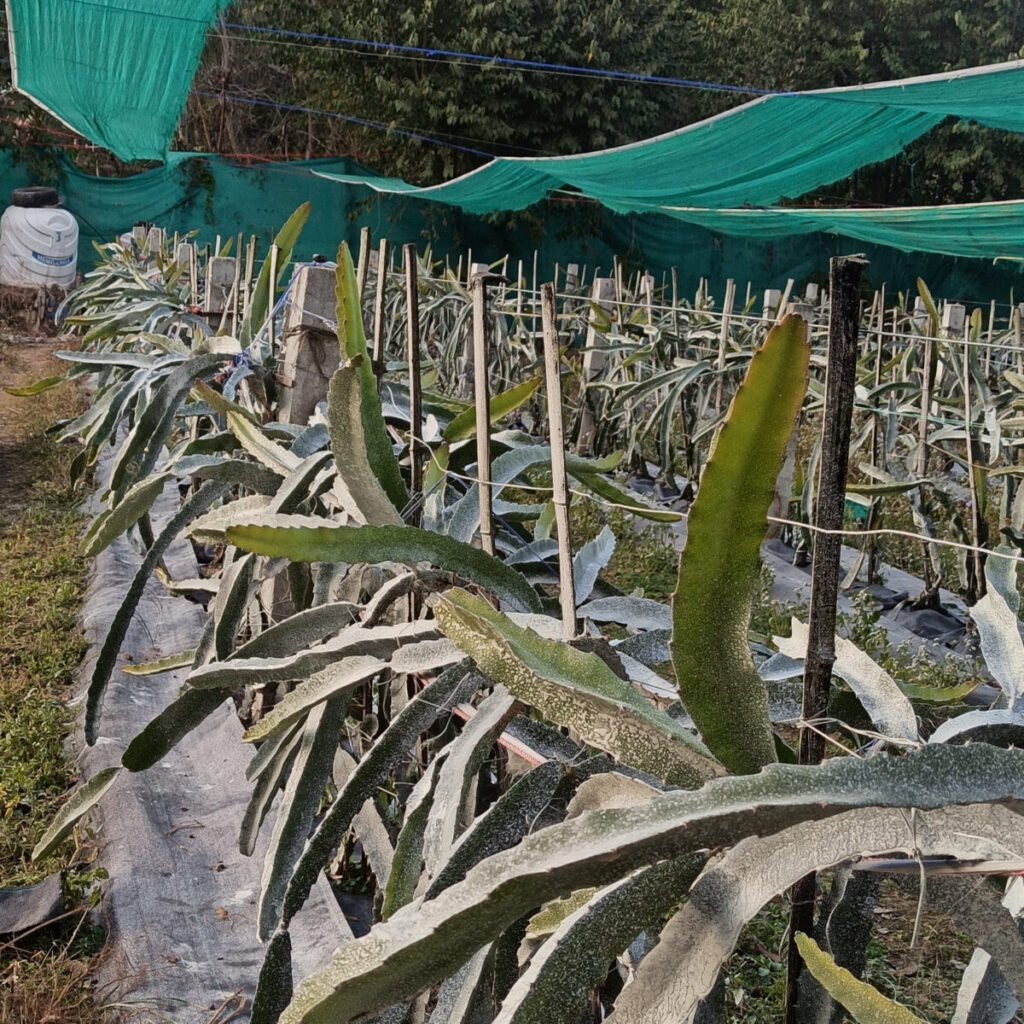
Unlike mango or apple trees, the dragon fruit plant (a climbing cactus) does not have a woody trunk. In its natural habitat, it survives as an epiphyte, using aerial roots to cling onto rocks and large forest trees.
When farmed commercially, we must mimic that natural support. A robust dragon fruit trellis system does three vital things:
- Bears the Weight: Supports 100 kg to 150+ kg of mature vegetative growth and heavy fruit clusters.
- Canopy Management: Allows branches to form an “umbrella” shape, which triggers and maximizes flowering.
- Airflow and Sunlight: Keeps the plants elevated off wet soil, reducing fungal diseases (like stem rot and anthracnose) while maximizing sunlight exposure for photosynthesis.
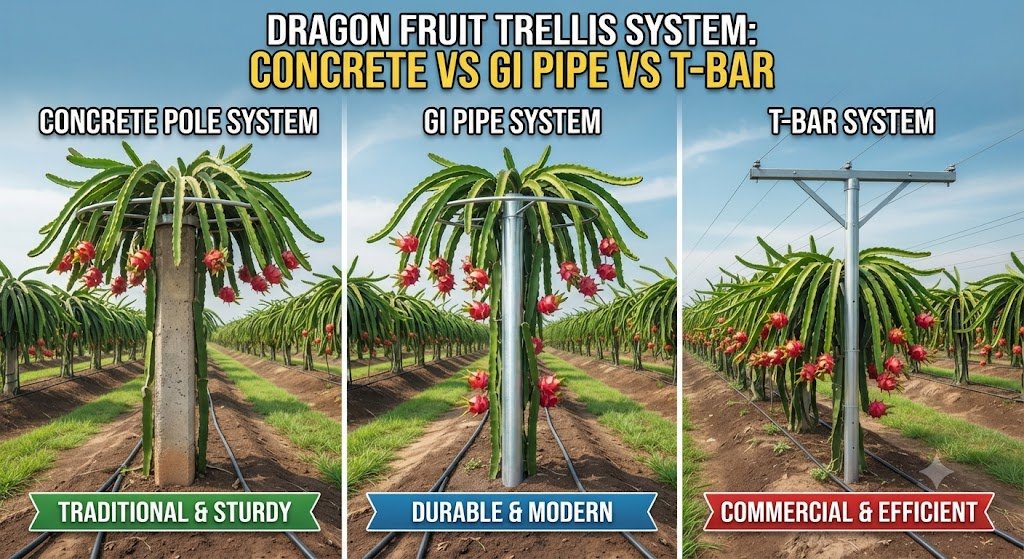
Option 1: The Concrete Pole System (The Industry Standard)
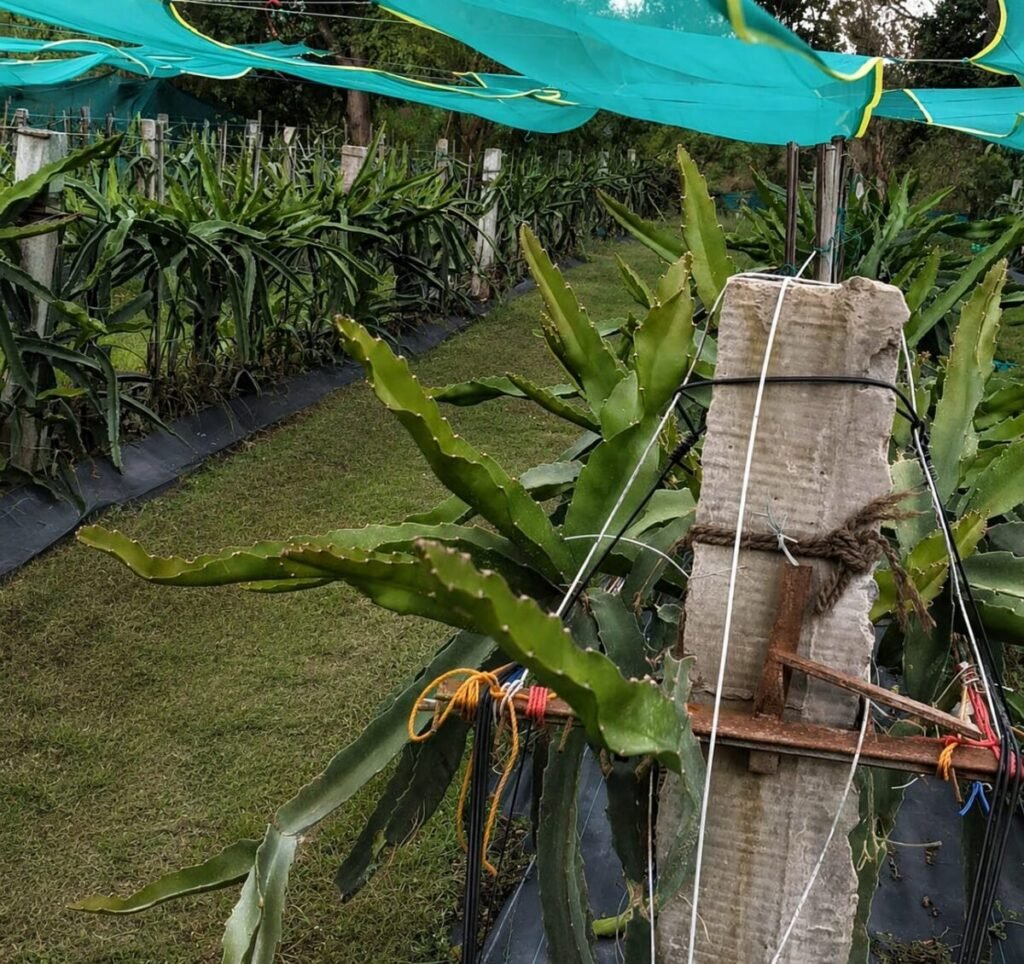
Walk into any successful commercial dragon fruit farm in India or Southeast Asia, and you will likely see rows of sturdy RCC (Reinforced Cement Concrete) pillars. When planning your dragon fruit trellis system, RCC pillars remain the gold standard. Using a sturdy concrete pole for dragon fruit provides unbeatable stability against severe monsoon storms.
Technical Specifications
- Pole Height: 6.5 to 7 feet total (1.5 to 2 feet underground, 4.5 to 5 feet above ground).
- Thickness: 4×4 inches or 5×5 inches.
- Top Ring: Made of reinforced concrete, or a discarded rubber tire mounted on crossed iron rebar.
- Internal Reinforcement: 4 internal steel rods (6mm to 8mm thick) with binding rings to prevent snapping.
Pros
- Unmatched Durability: Easily lasts the full 25-year lifecycle of the crop.
- Temperature Neutral: A well-cured concrete pole for dragon fruit does not conduct extreme heat, protecting sensitive aerial roots from burning when summer temperatures cross 40°C.
- High Load Capacity: Handles 150+ kg canopy loads with zero bending.
- Zero Maintenance: Immune to rust, rot, and termites.
Cons
- Labor-Intensive: Each pole weighs 40 kg to 60 kg, demanding significant installation labor.
- Initial Capital: Evaluating the upfront dragon fruit pole setup cost is essential before committing capital to a multi-acre project.
- Curing Required: On-farm casting requires 15 to 21 days of water curing before installation.
💡 Pro Tip: Never place bare iron rings directly under the canopy. In peak summer, heated metal can scorch green stems. Always pad the ring with used drip lateral pipes or a rubber tire.
Option 2: The GI pipe trellis system (Modern & Lightweight)
For growers seeking faster installation or managing leased land, the GI pipe trellis system has emerged as a popular modern alternative.
Technical Specifications
- Pipe Diameter: 2.0 to 2.5 inches (nominal bore).
- Thickness / Gauge: Heavy class (minimum 2.5mm to 3.0mm wall thickness).
- Top Fixture: Welded metal cross with an insulated circular ring or heavy-duty agricultural bracket.
Pros
- Fast Installation: A major benefit of a GI pipe trellis system is rapid installation without requiring heavy manual handling or specialized machinery.
- Factory Precision: Standardized wall thickness and zinc coating quality directly from suppliers.
- Resale Value: Retains scrap value if you ever decommission or relocate the orchard.
Cons
- Heat Conduction: Metal absorbs solar radiation quickly. Before finalizing a GI pipe trellis system, ensure you insulate the metal against intense direct sunlight using coir rope or reflective exterior coatings.
- Corrosion at Base: Risk of rust where the pipe meets moist, fertilizer-rich soil if not properly tar-coated or sleeved.
- Bending Risk: Thinner pipes (below 2.5mm) will bend under severe storm gusts and mature fruit weight.
Option 3: The T-Bar Trellis System (The High-Density Approach)
The T-Bar system (also known as the Fence or Trellis-Wire system) treats an entire row as one continuous trellis rather than isolated poles. The T-Bar setup offers an alternative dragon fruit trellis system focused on high-density row cultivation.
Technical Specifications
- Posts: Heavy end-posts anchored with guy wires, with intermediate T-posts placed every 10 to 12 feet.
- T-Arms: Horizontal crossbars measuring 2.5 to 3 feet wide.
- Wires: High-tensile galvanized steel wires (3.0mm to 4.0mm) stretched tightly across the crossbars.
Pros
- High Planting Density: Accommodates 3,000+ plants per acre compared to ~1,700 plants in single-pole setups.
- Streamlined Maintenance: Continuous linear hedgerows simplify pruning, automated spraying, and harvest operations.
- Superior Aeration: Canopy spreads along a linear plane, minimizing trapped humidity inside the foliage.
Cons
- Domino Effect: If an end-post loosens or high-tensile wire snaps under monsoon loads, an entire row can collapse.
- Intensive Pruning: Requires strict weekly pruning discipline to prevent branches from shading inner layers.
- Tension Maintenance: Wires must be re-tensioned seasonally using turnbuckles.
📊 Comparative Overview
Selecting an optimal dragon fruit trellis system depends on land tenancy, climate, and available labor. Opting for a concrete pole for dragon fruit ensures isolated safety; even if one post weakens, neighboring plants stay upright.
| Feature | Concrete Pole System | GI Pipe System | T-Bar System |
| Lifespan | 20–25+ Years | 10–15 Years | 15+ Years (wires require servicing) |
| Initial Investment | Moderate | High | Moderate to High |
| Thermal Protection | Excellent (does not overheat) | Poor (requires insulation) | Good (canopy shades support wires) |
| Installation Labor | Very High | Low to Moderate | Moderate |
| Structural Risk | Minimal (isolated posts) | Low (gauge dependent) | High (row-level domino risk) |
| Planting Density | ~1,700 plants/acre | ~1,700 plants/acre | 3,000+ plants/acre |
Height and Spacing Guidelines
Proper spacing across your dragon fruit trellis system guarantees tractor access and easy harvesting.
- Total Pole Height: 6.5 to 7.0 feet.
- Underground Depth: 1.5 to 2.0 feet anchored firmly with compacted soil and concrete rubble.
- Above Ground Clearance: 4.5 to 5.0 feet. This keeps fruit clusters at chest level, eliminating ladders during harvest.
- Standard Field Spacing:
- Manual cultivation: 10 ft row-to-row × 10 ft pole-to-pole (~430 poles/acre).
- Tractor mechanized: 12 ft row-to-row × 8 ft pole-to-pole (~450 poles/acre).
Final Verdict: Which Structure Fits Your Farm?
So, what is the final word when selecting your dragon fruit trellis system?
- Choose Concrete Poles if: You own the land and want a permanent, 20+ year installation that withstands intense summer heat and requires zero ongoing maintenance. Keep in mind that while your initial dragon fruit pole setup cost may seem significant, durability over 25 years offsets the expense.
- Choose GI Pipes if: You are operating on leased land, face acute farm labor shortages, or prioritize rapid setup and future scrap recovery.
- Choose the T-Bar System if: You have experience with intensive canopy management and wish to maximize early yields via high-density planting.
🙋♂️ Frequently Asked Questions (FAQs)
Q1: Which dragon fruit trellis system provides the longest commercial lifespan?
The RCC concrete pole setup remains the most durable choice, easily lasting 25+ years without structural decay or rust.
Q2: How do you prevent tilting in a concrete pole for dragon fruit?
Dig at least 2 feet deep, backfill with concrete rubble or gravel, ram the soil firmly, and pour a 6-inch concrete collar at the soil line in sandy or wet soils.
Q3: How many plants should be planted per post?
The commercial benchmark is 4 plants per post (one on each face), secured with soft cotton fabric or agri-tie strips until aerial roots anchor into the pillar.
Q4: Can bamboo be used instead of concrete or metal?
Untreated bamboo decays within 18 to 24 months due to irrigation moisture, causing the heavy canopy to collapse right when the orchard enters peak yield.
Q5: What is the average dragon fruit pole setup cost per acre?
For an acre with 430 to 450 poles (at 10×10 or 12×8 spacing), the typical pole and ring infrastructure investment runs between ₹1,50,000 and ₹1,80,000 depending on regional steel and cement prices.